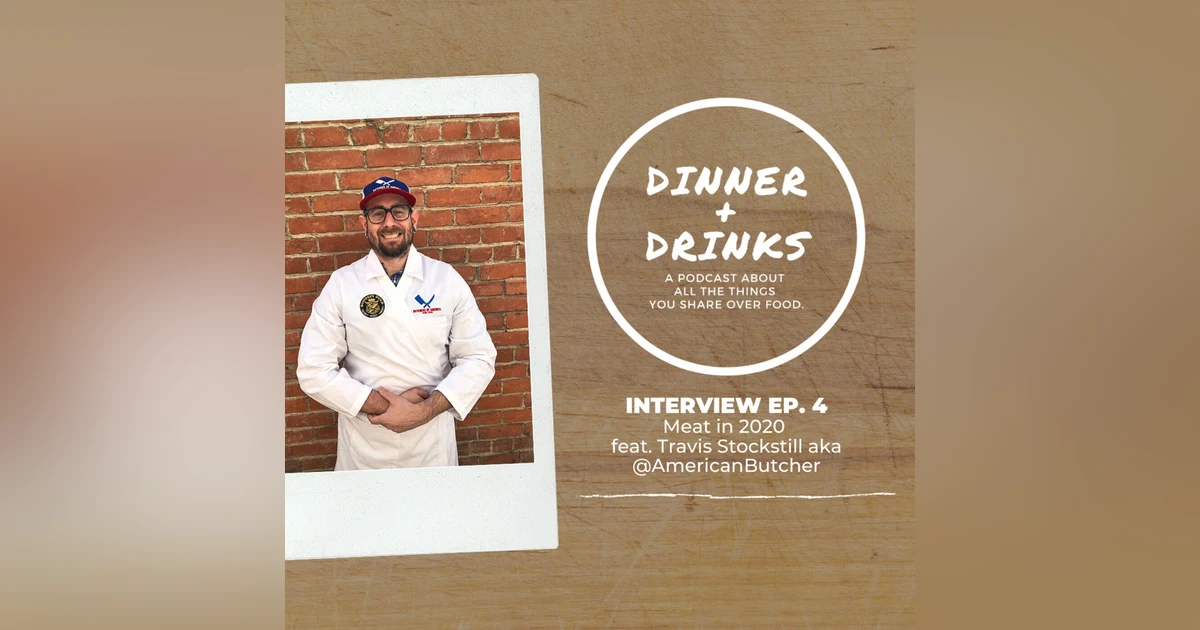
Meat in 2020 with Travis Stockstill aka @AmericanButcher


 Apple Podcasts

 Spotify

 Overcast

 PocketCasts

 RSS Feed

 YouTube
We wrap up our series of 2019 look backs and 2020 look aheads with this interview. This episode, we are joined by Travis Stockstill, who may be better known as @americanbutcher on Instagram. Travis is a talented butcher, who in addition to his day job, hosts The Meat Block podcast, and is a member of Team USA for the the 2020 World Butchers' Challenge. We discuss:
- Travis' journey to becoming a butcher.
- Cuts of meat, flavors, and other meat trends in 2019.
- What we're expecting to 2020, how we feel about meatless meat, and more.
- Team USA, the Butcher's Guild, and the World Butchers' Challenge.
Do you want to support Travis, and learn more about what he does? Here are some links:
- Travis' Instagram @americanbutcher
- The Meat Block podcast on iTunes
- The Meat Block podcast on Stitcher
- Travis' Patreon - if you're not aware of Patreon, it's an easy way to support the content he is creating through a small monetary donation.
Want to get in on supporting Team USA and their battle to be crowned champions at the World Butcher Challenge? Get more info here:
- The Butcher's Guild - a fraternity of meat professionals, and the organizer of Team USA.
- World Butchers' Challenge Team USA 2020 - learn more about the team!
- Butchers of America Go Fund Me - support Team USA with a monetary donation!
Thanks for listening - we'd really appreciate your feedback on these episodes! Please rate, subscribe, and review. You can always drop an email to hello@dinnerplusdrinks.com or fill out the contact form on the blog post for this episode.
Cheers!
You don't want to be stagnant because then you're only ever going to be good at that one thing. So I enjoy um, from a cutting standpoint, an evolving cut sheet and experimenting with new things.
SPEAKER_01Happy New Year's Eve Eve, everybody. It is Nick Vorpagel from Lake Geneva Country Meats, and we are wrapping up our 2019 Look Back and 2020 preview episodes here on the Dinner Plus Drinks podcast interview series. I am so excited to bring you this one because we are looking at meat in 2020. After talking about wine, beer, flavor, we are to meat, and we have a very special guest, somebody I was very excited to get. It's Travis Stoxdill, aka at American Butcher on Instagram. In the butcher world, he's kind of famous, kind of a big deal, so really excited to have him. We discovered Travis's Instagram a while ago here at the shop, and me, the butchers, everybody here, we all love looking at the cutting demos he puts up on his Instagram. He has videos that are really instructive and interesting, and he also has a lot of really nice pictures of all the cuts of meats he makes. It's really cool to watch. Highly recommend you check him out at American Butcher. In addition to the Instagram, Travis hosts his own podcast called The Meat Block and is a member of Team USA that's going to be competing in the World Butchers Challenge this September in Sacramento. All in all, he's the perfect person to provide perspective on what's happening in the meat world. So take a listen as Travis shares how he got into butchering. He explains why he shares all the things he does on Instagram, and what he's seen in his butcher shop that's located out on the West Coast. I think he has some great insights on trends that are occurring in the meat world. It's well worth a listen. And to top it off, Travis and I talk about the World Butcher Challenge and how we can all support Team USA as we take on the world. Nothing like going and supporting Team USA versus the world. So you definitely want to stay tuned for that discussion. Enjoy. Travis, thanks so much for joining me tonight. Uh really appreciate it. We're headed into the busy season of the year, so your time's super valuable. How are you doing tonight?
SPEAKER_00Uh I'm doing good. I that's my dog drinking in the background. He sucks. Um yeah, I'm just getting ready for Christmas, sending out a bunch of dry age roast to various um places, and then yeah.
SPEAKER_01Um are you doing mostly beef or any other? I know we have some places around here that do dry aged duck, um, just beef or mostly rib roast. We do a lot of rib roasts, and that's about it.
SPEAKER_00Yeah, so uh with the program I have at my work, we take the essentially what you call like the money cuts off of beef and then dry age the loins and then uh part them out to local restaurants or local chefs. Uh, we don't do any duck. There's a place further down south, Heritage Meets, that does uh a dry aged duck.
SPEAKER_01I am not sure how I feel about the dry age duck. It was cooked well, but I don't know if it's if it's for everybody. I I enjoyed it, but I don't know if everybody would. So, Travis Stocksdale, you are maybe best known as at American Butcher on Instagram. For people that like Meatstagram, you are the essential follower. You have the Meatbock podcast, you're a member of US butcher team. I know, you know, when we see the bio on you, it mentions that your great-grandfather was a butcher. But could you tell us a little bit how did you become, I don't want to say the face of craft butchering in America, but definitely one of the faces, one of the very public faces of the movement to know your butcher and know your meat. How how did that happen for you?
SPEAKER_00Uh yeah, I certainly don't want to say I'm the public face. Probably out there.
SPEAKER_01Um all our guys like watching you.
SPEAKER_00Yeah. Um well, so my great-grandfather being a butcher, then um isn't isn't cohesive to to my career, it's just more coincidental. Um, and then my brother's a butcher, my brother-in-law is a butcher. I've met my wife in a butcher shop, and my grandfather was regular grandfather, also used to butcher game and things like that. Um yeah, I forgot the question. Oh uh, yeah, so my grandfather's role didn't have a a you know, my great grandfather never met the guy. He did die at the age of 90 uh breaking beef. Um he just weird history. He he doesn't know his he never knew his actual parents, uh is the time when during the uh Native American wars down in the south, he was like kidnapped by the Native Americans and then raised by them. So it's um just weird history. Um but he ended up uh buying ranch land in New Mexico that um my that's still in my family to this day. Um that I've been at, you know, their sheep and a small working farm and things like that. It's been years since I've been there, but I used to go there when I was younger. Um and then getting into the career of the actual industry itself, I was uh a journeyman tile setter, and then the 2008 economy collapsed.
SPEAKER_01And not good for people in trades.
SPEAKER_00Yeah. Uh and my brother, who was already in the industry at that point, uh working at the the fabrication. And I'm just gonna do like I did a podcast like recently. Um, I use the term slaughter. Uh yeah, slaughter's good.
SPEAKER_01Okay, because I know everybody likes harvest, but slaughter's fine.
SPEAKER_00Yeah, uh, I did one and got some feedback that they couldn't even release it. And if you listen to my podcast, I say whatever I want. Um, but uh yeah, so uh got a job working in a slaughterhouse and just uh move moved up. I was single at the time, which is something you could do when you're single, is is move up and um took different positions, worked those horrible, horrible shifts, pretty much uh focused on upward mobility, and then uh through serendipity, I got a I w ended up going to high school with this girl who opened up uh the the quote unquote uh best butcher shop in America and uh in Southern California, then I she hired me. We weren't friends in high school, it's just she was in the meat industry and I was a butcher. So through social media, uh um yeah, she jokingly said, Yeah, if you ever want to come back to California, I'll hire you. And I ended up uh being there, uh working there, and then just using not using that, ended up being a platform to meet um my wife, who is honestly the main motivator of uh when I was ready to jump ship putting my resume together, then seeing how much money I can make.
SPEAKER_01That's awesome.
SPEAKER_00Yeah.
SPEAKER_01What um so you know, 2008 hit, you went into meat, obviously, because I'm assuming it was it was a better career option, but what was it or what is it about meat that made you want to stick in it, made you want to grow in it? Was it just money, or is there something you enjoy about it? And you didn't just do move up, move up, move up. You start an Instagram account, you started a podcast, you joined the national butcher team. That speaks to a passion. Um, yeah. What is it that did you find that passion right away, or what was it that helped you find that?
SPEAKER_00Um no. I I love the honesty. Yeah, like I I don't have that uh I didn't have that romantic idea about like wanting to be a butcher and all this stuff. I was uh I moved across the country because work was really hard to come by. Um and then about two years in when I got uh my company paid for me to get my humane handling uh certification and my HACCP certification.
SPEAKER_01And um and these are very important food safety USDA uh regulated things for people that might not know what those are. But if you're a USDA inspected slaughter plant like we are, like like your employer is, you have to have these certifications. These are very important.
SPEAKER_00Yeah. And uh around that time, I just realized that I I was two years in, had these certifications, and that I should stick with it. Uh when I moved out to Vermont, my brother said if I give him three years of my life, he'll turn me into a into a butcher. And uh I was there for two years, and then uh, you know, one day I showed up to work and I wasn't well, also I met the salary cap at the kill floor, and so one day I showed up instead of having blue uh like Rosie the Riveter uh coveralls, I had white frocks, and then I was um told I was gonna be in the cut room from there on. Um nice, and we were doing uh in this is back when social media was like dead. There's only like 10 of us back then. Um and so the name American Butcher was uh available. Um and so like I was wondering how you got that.
SPEAKER_01I mean, it's a great name.
SPEAKER_00Yeah. Um and uh online tutorials were were bad. Um but I watched a lot of them, I learned a bunch of techniques. I had the fortunate opportunity of working cutting at that facility. It was a cut and wrap. So one animal could be cut this way, one animal could be cut a different way. You could cut if you do chucks all day and you do 30 head, you could cut chucks 30 different ways, you know. So it just um, and I was fortunate enough to work with other people who were generations deep in this industry. And I mean, like their parents had butcher shops, their grandparents had butcher shops, you know. I worked with this one guy who is from uh Brazil, who is still to this day is one of the best butchers um that no one will ever know. Um I just cause he doesn't have social media and he cut circles around me. Um but around you know, being in the cut room and then learning these skills, and then you know, I realized that I needed to focus all my um energy into that, that like I was um I I don't want to sound arrogant, but I realized I was becoming fairly decent at it. Um and I started posting online, and then the response back then was people were uh I always use the phrase like what's obvious to you is amazing to others, because at that point it was just my job, and it was just like every day, and then getting this feedback from people in the industry uh of other butchers saying, wow, that's cool, or like working with whole carcass, then it really affirmed that um I was in a the cut and wrap side of the industry where a large portion of butchers or meat cutters don't don't deal with things on the rail and don't deal with the slaughter. So even getting that feedback from um other cutters perpetuated my taking pride in the uniqueness of um uh of the scarcity of the trade, I guess.
SPEAKER_01At that point, it is it is, and one of the things that you know we talk about a lot is in our industry is how do you train people when there is a scarcity of uh facilities that do stuff off the rail where you can have the experience of being on the slaughter floor, but also cutting. Because I think a lot of people, our guys, have um similar story to you where they started on a on a slaughter floor and then you know to move up to get more stuff started cutting, but they had both experiences, and it's not necessarily like a career path, it's just a it's a way to get get more money, yeah. Um and for people that are looking for uh unfortunately your Instagram gets flagged as sensitive content sometimes these days, so does ours, which is ridiculous. It's yeah, not like we're uh I don't know, you can have a full rib roast and cut that, and people think that's sensitive. But you show a lot of really interesting techniques and cool things that you can do with meat that go beyond the standard here's a New York strip steak. Um you had a snowman up the other day, um, but you'll show a lot of interesting techniques.
SPEAKER_00Do you find a lot of pride or pleasure in finding new ways to cut in the seams of like a beef shape? Find a cut out of something like a chuckle. See how many pieces you can take off of it. 30 different ways of doing it.
SPEAKER_01That being said, the business side of 30 different carcasses, or do you prefer reflecting the one way of doing the same thing? I think that's like everybody's dilemma. Man, it'd be great if we could cut everything standard. It kind of gets boring.
SPEAKER_00Yeah, so when I uh will post something that's more um you know, esoteric or avant-garde or whatever, it's because it's a slow day.
SPEAKER_01Um fair enough, man.
SPEAKER_02Yeah.
SPEAKER_01Um we're doing the series on kind of wrapping up 2019, looking at 2020. Um, your current positions with Jack Mountain Meets, uh, you're out in Washington State. Um, we wanted to talk to someone from the West Coast, because you guys are are usually a little ahead of what we do here in the Midwest. And you also do a lot of work for restaurants, right?
SPEAKER_00Yes. Yeah, we do. Uh so essentially we're a whole carcass USDA smokehouse. So we receive whole carcasses and turn it majority into 100% added value product, such as uh sausages, hams, bacon, uh smoked products, things like that. Um smoked sausages, raw sausages. But we end up with um cuts that would make sense to sell wholesale as well, because we also want to be sustainable and want to um maximize money and growth so we'll have you know pork chops, rib roasts, things like that. The we work with the chefs uh weekly to help adapt things for their for their ever-evolving seasonal menus. Um and it's um I don't know. If you have chefs chefs listening, it seems like you guys can make my job easier. I would agree with that.
SPEAKER_01Chef make our job easier. Yeah, there's only so many one-inch, 10-ounce pork chops on a pig. We can't give you all of them.
SPEAKER_00Yeah, so so that's that that's what we do is um, you know, we have set deliveries and a bunch of we cater to a bunch of restaurants in uh Seattle in the greater Seattle area, high-end dining experience. Uh, you know, we'd like to say we sell a premium product, which means you have to when it comes to your pork products, it's really got to be premium, uh, because it's hard to get a good margin on pork beefs easy. Um yeah.
SPEAKER_01So the pork is that how are you one of the things that I I love, you know, what we'd call heritage breeds of pork, um, different color, different flavor, more marbling. We've had a hard time getting people here to accept um, you know, it's been a struggle to get cook your pork chops to 145, cook your pork chops to 145 people. Um but then getting people to pay a premium for a fattier, more red meaty type of pork chop is just not it's gone over like a lead balloon. Uh do you find acceptance for that? Uh, you know, near Seattle, or is that a struggle for you as well?
SPEAKER_00Um we're we're selling we're maxing out on our pork production because we have our added value program. Um, and we're you know, you go find our pork shops and um local grocery stores up and down the uh here in the Pacific Northwest. Um what we're our outlets is because you know, when we sell to certain companies, uh they have a eighth or a quarter inch fat cap that they want, or they have restrictions in them with Heritage Cross that we have and with their diet that we receive, they have um more than an eighth inch of fat. And so we have to find an outlet um for back fat, for leaf lard, for organs. And you know, we work um in bones a lot of times. Luckily, you know, we um work, you know, there's a couple ramen places there is that will take the bones. Uh we uh give the leaf lard uh to um a local uh soap maker who makes artisanal handcrafted soaps out of it and sells them at the farmer's market. Uh the back fat, uh right now we're giving a lot of it to uh game processors because we're in the game season. Um and then anything that's left over, uh people have the fear that things go to waste. And I more or less had the fear of losing money. But uh so we have a rendering company that we pay for to come out and then they'll take all of our extra fat, all our extra bones, and the the nasty bits that we we tried hard to sell. And trust me, I'd rather sell it than pay someone, you know, uh to pick it up. Um and they turn that into um soil enrichment programs or uh, you know, proteins for animal food and possible cosmetics. So cosmetics. Yeah.
SPEAKER_01So it's that's what nobody wants to know.
SPEAKER_00Yeah. So it goes full full circle. Like, you know, it like so that people always have this fear of of a waste in the industry, but if you have a rendering company, it's not going to waste, you know, people gotta figure out how particle particle board is stuck together. It ain't plant-based glue.
SPEAKER_01That's right. Yeah, that's a good point. That's a nice next time uh we talk about sustainability, I'm gonna bring that one up.
SPEAKER_02Yeah.
SPEAKER_01So on the fresh cut side, I want to get to some of the value add in a little bit, but are there things that you know, and you're out and about, you know, you're not processing as much beef, but you see it. Are there cuts or ways people want cuts that you think are, you know, something that hit really popular in 2019 that you hadn't seen before? Or as you're looking at your cut sheets, people are just ordering this, ordering this, ordering this. That you said, man, we're cutting a lot more of these than we used to, or something that just went away.
SPEAKER_00Yeah, um, I don't know if it's just because of one customer, but we are getting consistent orders for boneless beef short ribs.
SPEAKER_01Yeah, we are too.
SPEAKER_00Yeah. So for they're not efficient. No, and they but they also wanted like not just like the Denver and the cross cross plate, they wanted like the whole plate bone.
SPEAKER_01Oh, really?
SPEAKER_00Yeah, and I was like, that's like a lot of fat. Uh-huh.
SPEAKER_01That's a lot of fat.
SPEAKER_00And I don't know how like I cooked one of my home recently, and it was pretty good. But um, yeah, so so we had that for for a while. Um and we had some restaurants were really enthusiastic about like the like save all the oysters or save all the terrace majors or save all these cuts until we got enough to um you know ship them a couple cases. Um you know, so we get that every once in a while. Nothing new has really happened this year that's like like I don't know. That's like mind blowing. But but I I think that the we're getting uh uh specialty grinds more.
SPEAKER_01Yeah, that's been a big thing that we've seen too. When you have a customer asking for save all the oysters, which there's There's two per per animal, one aside. Um do you think that's something that is I I don't know how to say this like healthy where you go to the grocery store, you go to a restaurant, and you can just order it, pick it up without understanding that there's only two per animal, they're scarce, they're expensive, they're hard to get, there's a sacrifice of of you know how much grind you can get out of that. Do you think it's a good thing that people can just get those widely, or do you think that's something people should have to go to a butcher shop and and understand a little bit that might be here today, not going to be here tomorrow?
SPEAKER_00Yeah, I always uh there used to be a bo butcher shop that I would go to that would have like a uh they received box products, but they would um have a whole tray of like terrace majors, you know, and like you know, 30 on the tray. I'm like, well, that's 15 beef. Um, and they're a whole, which is you know, means they're breaking them in a certain way. But the way we break for economics points to save the terrace major, it's not cost effective for us. No, it's not. Uh so we want to we personally want to put it in grind, or you may end up with a small terrace major. Um it in with the I have more I'm more okay with like the oyster, but like getting the mouse meat and different muscles off the sirloin is like a pain um that people want to showcase. Um I think that they're if you had that communications with your buyers and the restaurants and things like that, and let them know that you're not gonna have um that that it's gonna have to be a rotating menu that if you're okay with putting that you don't have it this week on there, then that's fine. And I think that you know, if I were to own a restaurant, I think that's how menus should work anyway, so you could invite new people in. Um, and then I think um the the one thing that I find frustrating is the the opposite of the the consumer at the retail level who read a recipe that's very specific to a cut because they a chef put it on there, and you they walk into your retail shop holding a piece of paper, and and then they want to know, do you have an oyster? And then you explain to them that, and then that sense of uh I want it now is is let down. But then again, like a good butcher could uh or a good retail person could steer them to something comparable. I don't know it'd be comparable to an oyster though, yeah, comparable to the recipe.
SPEAKER_01Yeah, no, that's a great point, though, of the people needing to be flexible. It I I have a friend who always said when you shop with the small butcher shop, you're always gonna make a little bit of a compromise. One of those is you know, we're close Christmas day, you know, so you can't go on Christmas. Um, you're gonna get great quality, but the same thing with that oyster is you're gonna make the compromises. Sometimes you're gonna get it, sometimes you're not.
SPEAKER_02Yeah.
SPEAKER_01Um so we do a ton of fresh sausage flavors here. Wisconsin, it's you know, heart of German immigration. We do everything from a traditional bratwurst to we do a curry worst once a year for our Oktoberfest. Um, we do we just added um a go-to jong brat that's really delicious. A lot of we're seeing a lot of um Asian inspired flavors, um a lot of chili pepper inspired flavors working our way into our fresh sausage with your value-added things like your sausages, your cured meats. What are you looking at? What are people looking for? We're seeing a surge in popularity. Is that something that you're seeing out there too, or is that a little different on the coasts?
SPEAKER_00Uh we're we're seeing a uh a growth in our menu. Uh and and you know, a large portion of our our business is added value with the cuts being second. So what we're our menus growing and our sales are going up. So that there is a pop popularity on it's becoming, I think our I don't know if it's sausage in general, but our brand is certainly taking up more of the market. Um, and then we're also expanding our menu to versus like you know, your your classic brats, your sweet, your hot, um, your uh we do two different types of breakfast sausage. Now we're we introduced a potato sausage.
SPEAKER_01Um we introduced especially popular this time of the year.
SPEAKER_00Yeah. Um we have uh an atomic brat that we're we're selling now that it's like uncomfortably spicy but still good. And uh we're you know, we want to uh open the door more of trying to be in that that craft raw sausage of like you know, experimenting with different high cheese meltings and things like that to do like a um a cheddar one, and then we're trying to uh come up with a uh ginger um wheatgrass sausage as well.
SPEAKER_01Oh, that sounds good.
SPEAKER_00Yeah.
SPEAKER_01My uh my pride and joy right now is, and this took me a couple goes at development, is we do a hatched chili pepper and cheese curd brat. Oh, nice with um some cheese curds from a from a friend of mine. And it was, you know, it's easy to say shove some stuff, some stuff in a sausage and it's gonna taste good. But getting that hatched chili pepper, that perfect like bite and roastiness that you expect out of that pepper, that was that was tough.
SPEAKER_02Yeah.
SPEAKER_01Do you um do you get much hands-on development time with the different value add stuff? Is that something you enjoy? Or um do you have someone else that does that a little bit?
SPEAKER_00Uh I'm we outsource the the recipe and the ratios, we'll come up with the ideas. Um, but when it comes down to the the ratios smart, save a lot of frustration, yeah. Um and then we'll outsource that to like a um someone who does that for a living. Um, and then we send it off and uh you know, we have things that give us the nut facts on it, and then more or less where I excel at is taking those raw materials and then making the coarseness, the mix, and the process um efficient and producing the best quality product that it can.
SPEAKER_01Uh how much of a difference do you think it's like a chef that's willing to give away his recipes? So it's still that chef has his technique, the equipment. Um how much of a difference do you think your skill and the quality of your facility and your crew has on, you know, there's a lot of people like to make sausage at home. It's fun. Uh never steer anyone away from that. How much of a difference do you think your your skill makes in the end product um quality?
SPEAKER_00Um I think I don't know. Oh I'm a little cocky, it's okay. Yeah, um I think my skill as far as cutting production and sausage making is um very good. Um, but uh that being said, my staff is trained up where I could plug a few people into the sausage line and they could take it over seamlessly. We have uh we any business should lean out their entire uh flow so you could make it um essentially um you know employee proof, where if you do things the certain way every single time, this will it's like following a recipe. Um I you know, a great home sausage maker would honestly be lost just coming into my work for the first time, but if I were to have to recreate some of these recipes on a much smaller scale using different equipment, um I would probably struggle with it a little bit as well.
SPEAKER_01Um that's an awesome answer. It's just a little different circumstances, yeah.
SPEAKER_00Um, you know, and like versus using like someone who mixes things by hand or uses like um a rotary mix or grinder system, you know, like where I work, we mix things in the bowl chopper.
SPEAKER_01Yeah. So it's a big piece of machinery that if you don't know what you're doing, you should probably stay away from it.
SPEAKER_00Yeah, definitely.
SPEAKER_01So I wanted to wrap up talking about the now by um something that's a big hot topic in 2019 was plant-based protein. Um I think Burger King kind of made a whopper of uh impact uh at the end of the year with doing the impossible whopper. And I was just kind of curious. Um, you previously were a vegetarian. Um, how do you feel about plant-based proteins? Do you think they're a threat? Do you think they're a compliment? Um, personally, I I'm open to them. I think there's a place for them. There's an interesting debate to be had with them. I have some concerns about um the proprietary nature of a lot of the uh recipes, uh, how how they're inspected. I I always say the thing people should feel the best about eating in the world is USD inspected meat. Um we undergo a lot of really strict inspection. So it seems like plant-based protein really hit it big this year. And I was just curious from your perspective, how how do you feel about it?
SPEAKER_00Um Yeah, so I was a vegetarian, uh, not at all for ethics um uh or animal rights, not saying like when I say that, it makes it seem like they shouldn't have rights.
SPEAKER_01But um you're a humane handling certified, you do you do a lot of work with them. I don't think anybody that's that close to I shouldn't say that. Most people that are that close to animals respect animals, yeah, treat them well, yeah.
SPEAKER_00But I was mostly vegetarian because I was straight edge when I was growing up, and it was just like kind of went hand in hand. Um but as far as you know, beyond meat and incredible and whatever buzzwords, it's really they're not taking our jobs. Um you know, I'm seeing a lot of stuff online where people in grocery departments are being like, I can't believe this is in the meat aisle. It's like get out, get over it. Um but you people need to recognize what what is the the goal, you know, is it to is it because you want to have an alternative for your vegetarian friend? Or is it because you want to uh feel good about a carbon footprint by having meatless Mondays? Um, or you just doing it for healthy reasons, where at that, you know, it's just so the buyer needs, you know, in theory, figure out what they're addressing, and then if you know they buy it because they feel good about the planet, then that's all to them. But uh, you know, maybe they should stop driving the car as well, or you know, uh buying uh single-use plastics, because all that stuff that is wrapped in is wrapped in single-use plastics. Um and then you have, you know, uh one of them has I want to say 23 ingredients where you're gonna have 23 different manufacturing and farming practices for for those ingredients where beef could just be could be one. Well, you know, it's beef, and then you have one farming practice and one thing like that. It's just to identify what are people trying to solve with it, and then a part of me also just think it's like the Furby where it's a fad, where um where it's a big thing right now, where it's like, you know, a couple years ago it it was paleo, then last year it was keto, and now it's counting macros, where it's just like you know, there's these different dietary fads that come in and out, you know, uh eight years ago it was Atkins. Uh then, you know. So I I think that there's always been the morning star fake meat area of the grocery store. I don't think that's any going anywhere. Um you know, but as far as like people who are switching 100% to a plant-based diet, that those numbers are more stagnant. It's like 3% of the population identify as vegan when 10% identify as anti-vaxxers.
SPEAKER_01So I didn't think of it that way. You're right though.
SPEAKER_00Yeah. So it's just those margins of people are the loudest.
SPEAKER_01Yeah. Yep. I want to transition to looking to the future a little bit. 2020. Are there any kind of industry trends, flavors, cuts of meat, ways of preparing things that you're looking forward to or hearing from your customers that uh you think could be something fun in 2020 that we can look forward to, or something painful, I guess, too, also?
SPEAKER_00Yeah, I think that uh as far as 2020, I I can't pr predict the future. I know that like um it seems like dry age pork is becoming more of a thing, and I want to know how that's gonna play out in a um in a wholesale sense.
SPEAKER_01Yeah.
SPEAKER_00Uh we've never tried that. Yeah, so I'm interested in the market for that. Um personally, as far as like products I want to push, I want to uh, you know, my work has these beautiful uh giant curing rooms that we we don't use. Um I would like to to do something possible possible with that. Uh I think it would be exciting in in 2020 if there were more uh every I go to these farm conferences once a year, and every time I hear, and I'm sure you've heard about people wanting more local processors or wanting more boutiques and things like that. I think that if um more people it would be exciting if this was speaking in the ether, if more people were to enter the the small USDA added value co-packing um business. Not necessarily slaughter, not necessarily this, because there's there's those places out there, but though a lot of those places in California and uh and here in Washington and in Vermont, I could only speak of places where I've lived, um don't do added value to the degree that other people can. And then the places that do are uh state inspected, so you can't sell it at a wholesale market or in a retail market. So I think that would be an amazing trend to see more people try to fill that niche because I think uh, but also they got to make money. So I would, you know, maybe a co-op model, maybe get farmers together. I'd like to see a lot more co-ops and uh more local things happen in 2020 uh than I've seen in in previous um generations. I also want to see I want to see more butcher shops open than close um in 2020. Uh um big thing is I want people to be you know stoked in I like I'm sure you get it all the time. People say, How do I get in this industry? And it's like I it people always ask me, but I'm always hiring, but they they don't want to work for me. I don't know. Yeah. Um yeah.
SPEAKER_01You gotta start at the bottom. I mean, it's that's the tough thing about this industry is you're gonna start at the bottom, you're gonna have some crap jobs. And if you prove that you wanna be here, you'll keep work and you and you'll learn skills and you'll move up and you'll make more money, and you'll you'll be somebody that's got a lot of it. It's just that the first I think what your brother said to you about you know, give us give me three years and and you'll be hooked, that's kind of what we see is you know, i if you get in this three years, you'll see you this is a good industry.
SPEAKER_00Yeah. And then another thing I'm absolutely excited about is the the World Butchers Challenge in 2020.
SPEAKER_01Yeah. I want to talk about that in a little bit.
SPEAKER_00Okay.
SPEAKER_01Um, but you said um you want to see more butcher shops.
SPEAKER_00Yeah.
SPEAKER_01And I wanted to ask you, what do you think the role of a butcher shop is in 2020? And and what do you think a butcher shop is? Is it um somebody opens up you know a shop in a strip mall in suburban area and says it's Nick's butcher shop, Nick's quality meats? You're buying in boxed beef and cutting it, and it's a good quality, and you know how you're cutting your meat, and maybe you make a little bit of fresh sausage. Is that a butcher shop? Is it someplace uh like us that we do custom slaughter still? Also retail. We buy in some we buy in a lot of boxed beef and pork, but we also do custom slaughter, do our own sausage makings in some place like you that's buying in uh slaughtered carcasses and doing value added from that. What what is a butcher shop in 2020?
SPEAKER_00So I think that like um I I think that I don't know, people get lost in the the terms of butcher, meat cutter, slaughterman, and all these things. And as I I uh I used to be like that, where I'd be like back when I was a slaughterman, I'd be like, you know, could say, Well, I'm a butcher because I do this, and then when I became a butcher, I'd be like, Well, now I'm a real butcher and not a slaughterman, and et cetera. Like it is just I it took me, I guess, until I was where I am now to realize none of that matters. Um, but I think that the general public uh wants, I think what you want to achieve as a butcher shop is a good relationship with the uh with the consumer and the customer. And a good butcher shop, regardless if it's box or on the rail, should be able to really have a dialogue and break down um what their customer wants and like give cooking advice, give uh you know, steer them towards another product if something's not available to uh have that personal relationship where they're not just pulling a ticket. Um I think that uh I love whole carcass uh boutique shops. I think they do some beautiful work, but I also know a lot that I've closed. And I think that for me, if you were to ever if someone be like Travis, why don't you open a butcher shop? I don't want to give my uh hypothetical business plan away. But what I would rather do is open up a uh like a smokehouse restaurant where and then have my business plan be 100% supported by how many seats and how many uh plates I could send out the door, and then have um a butcher shop that could feed into that more as a hobby and not as a sense of making income. And I think when you see those butcher shop restaurants combos where they could uh unload excess product into the restaurant, uh you're gonna start seeing more success. People like the um like seeing stuff on the rail and they like seeing swinging carcasses and want to have that uh big meat cheese mob out of it, but like box meat also needs to be a factor. And what I would also encourage people who do buy box meat is buy the more uh unique cuts to give a variety because it all has to be used to have a sustainable um you know relationship. So you're gonna need eye arounds, you're gonna need this, you're gonna, you know, you could possibly, if you do your in-house grind at that point, could uh boost your margin versus just grinding chuck or buying, you know, different things like that. Um, you know, there's a couple um custom slaughter retail shops that I've been to, um, and I love them. Uh I just don't know the the general publics uh because I'm I don't consider myself a a in the general public when it comes to like meat buying what their take would be on going to a place to buy um uh a fresh cut or frozen cut of meat where um it also died. I feel like that may be too um real for some people.
SPEAKER_01Yeah. I think the other challenge with that is somebody comes in, it's Christmas Eve, they want a tenderloin, this is one time of year they buy tenderloin, it's important to them and their family. Say, you know, actually we sold out a tenderloin, but how about a mock tender from Juck?
SPEAKER_02Yeah.
SPEAKER_01It's not the same. I mean it's fine, it's a good cut, it's a good value, but it's not a tenderloin. And that's I think you're right. Boxed beef has a place. We um we're gonna go through about 400 whole tenderloins in the next five days. Yeah. That's 200 head of beef. That's you know what, 200 pounds of ground, 180 pounds of ground beef an animal? There's no way. It's just not responsible, it's not sustainable. So and there's one more thing you hit on there I wanted to ask you about. Do you feel that butchers in 2020 have more of responsibility on let's call it the culinary side, whether they're cooking themselves or giving people advice on how to cook at home than they did in the past? Do you think it's not really important to being a butcher, or has that always been part of a of being a butcher? Is telling people how to cook things, cooking for people, that sort of stuff?
SPEAKER_00I think it personally, um a a good butcher, what I would consider as a good butcher, would be able to tell you uh a simple recipe, nothing, nothing outrageous, you know. Uh they certainly don't need to have four recipes per dish and tell you the the the cooking technique, if that is, you know, sear, flip, put in the oven, your oven set for this. You know, they should always have the line memorized, cook to temperature, not for time, because every every oven's different. Um, and I think those, even uh, though they're not like necessarily culinary, um you know, it's more just cooking advice. I think that goes really far with the customer versus how should I cook this? And someone just looks at me, I don't know.
SPEAKER_01You know, yeah, like all-time great customer service response.
SPEAKER_00I don't know. Yeah, where it's like it um, and then I think I am well, I would take pride in knowing that I helped them have a good meal, and I would always want to have the answer, even if I didn't know it, I would be like, Well, let me look that up for you. Let me the and I think that communication, you know, um, it also develops because a lot of people may just see it as a as a job and not a career. Um, I think once you make that jump into career, then you start paying attention to things like that. Um, and I think, yeah, all then talking about like yeah uh culinary and stuff like that, it just made me think that how uh all chefs want to be butchers, but no butchers want to be chefs.
SPEAKER_01That's true, that is true. Oh, we I love chefs coming in. Hey man, can I come in and cut for a day?
SPEAKER_00No, no, no, and like a part of me wants to be like break down, like man, that's insulting because you're not gonna you're not gonna learn anything. All you're gonna do is slow down my day.
SPEAKER_01I appreciate we always love to have them in, you know, we try to teach and and share because it's good that they take an interest and want to learn, but it's also like, man, I don't come in and try to do omelets on your line for fun.
SPEAKER_00Hey, could I just throw me in the line? I have no idea what I'm doing, by the way.
SPEAKER_01We'll be fine. We'll be fine.
SPEAKER_00I cook it home, it's fine. Yeah, it's just different scale.
SPEAKER_01I think it's like you said about home sausage maker versus making sausage on an on scale. Different talents, different scales. Yeah, let's appreciate each other. So the really exciting thing coming in 2020, and you're uh you know, a member of the U.S. butcher team, is basically the butcher world cup, butcher Olympics, whatever you want to call it, call it, are coming to America, coming to Sacramento, and um as part of the Butchers Guild, you're competing in this. What uh what what's the deal?
SPEAKER_00Um, yeah, so it's the 2020 World Butchers Challenge. Uh it's America's second time competing. Uh in 2018, there was 12 countries. Now there's 16 countries in the event. Um it started off nine years ago between a uh Australia and New Zealand uh in a field, uh just a friendly bet over a bottle of whiskey. Um and then jumped now nine years later, which was like uh you know just a competition between Australia and New Zealand. Now there's I'm gonna miss somebody here, but there's uh you're gonna cause an international incident. Yeah, if I try to name them all. But uh let me see uh Greece, Bulgaria, France, Germany, Wales, Ireland, Great Britain, Brazil, Mexico, Canada, uh, America, and there's like a bunch more.
SPEAKER_01I should have kept counting. You I you got pretty close to 16.
SPEAKER_00Yeah, I think uh South Africa and maybe not, I don't know. Uh but yeah, sorry if you're listening and you're from one of those countries. That's uh you should be from a country with that I could remember better. Um I'm joking. Um, but now yeah, it's this huge event, and uh so there's each so there's 16 countries, six uh butchers on each team, and they say it's like the best butchers from those countries. I'm uh I that's certainly not the case with me. I just had the presence to get on the team. Um and then you have three hours and 15 minutes as a team to break down a half beef, half hog, one lamb, five chickens, and to 100% added value product while making a pork sausage, beef sausage, and a gourmet sausage. Um, you can make more sausages if you want, but those are the those things, and you're uh judged on um you know things as far like from your communication, how well you communicate with your teammates. Uh you know, you're judged on keep putting your knife back in your scabber. If you start with a white frock, it needs to be white at the end. You know, you need to think about your purge and your cutting and uh things like that. And then at the end, you need to have your block um wiped down as if it was pre-op ready. Um, and that is not like after, it's not like and time now cleanup, it's the cleanup is part of the the time trial.
SPEAKER_01That's insanity. I mean, it's basically like iron chef. Yeah, but instead of getting the ingredients, you have to get the ingredients ready. You have to then make something value added, and then you also have to make it beautiful because presentation is a big part of this too, right?
SPEAKER_00Yeah, so like you get presentation and practicality because you see all these beautiful things out there, but like how practical is it? Um, because I could I could do many things with meat and make it look make a snowman, yeah. Make a snowman, but you're not gonna serve that, you know. I don't know, I might yeah, um, that also involved a power drill. Um uh but you know, it's like these um these cakes or like you know uh certain you know like layered meat products that like well, how would you actually cut a piece of that for a customer? How would you, you know, with using uh whipped fat as more or less a a frosting in some things? It has to be um and also uh they're gonna go by and they're gonna uh pick a one product and cook it. So to see if your vision of that product it will will be good uh in that in that time frame, you know. But then there's also like creative uh freedoms with it, because like you know, some teams made hamburger uh patties, beautiful hamburger seasoned and all these things, but they put them on like their display was on like brioche buns. It's like, well, that's congratulations, you can throw out that bun. Yeah, you know, so so there's there's some leniency with that, but it it's um yeah, and you get marked down if you if uh someone says, Hey, what where are you now? And they they don't answer your captain right away. Um and there's judge there's a judge from each country who's not competing, and then so there's 16 judges judging you. Um actually it's 15 because your own judge can't judge your team, but um, or your own country's judge can't judge. Uh so it it it's yeah, and preparing for that is is you guys practice a lot, yeah. And our practices um are mostly uh coming up with ways to raise money because uh it's expensive to get us all in one place and give us uh get pr product to practice on. And you know, myself, I'm in the Pacific Northwest, and luckily most of our practices are in uh Sacramento. So for me, it's just an hour and a half flight. But I have a teammate, Brian Mayer, um, out in Hawaii, uh Kevin McCann's out in Rochester, New York, um, Brian Butler's in Austin, and then Danny, my team captain, and Paul are uh located in uh Sacramento. So that um and the reason we practice there is because they have a shop that allow us to um that has a great space and is big enough and is closed certain days of the week. And then Tucker, I forget where Tucker's from, who's uh the apprentice cutter. So if you're listening, I'm sorry, Tucker.
SPEAKER_01Yeah. So if people we've supported um the team by buying some merch. You guys have some awesome merch, really neat hats, other things. Uh we've bought knives from um F Dick, who are one of the sponsors. Um really great knives. How are some ways that if people want to learn more about World Butchers Challenge, US Butcher Team, um, how can people go learn more about this really pretty awesome thing that everybody in America wants to be team USA? So how can we get behind Team USA?
SPEAKER_00Well, so uh as far as learning more about it, uh, you know, Team USA Team USA is put together by um the Butchers Guild. So we're we're all members uh of the Butchers Guild. And if you go to the Butchersguild USA.com, I believe, um, I'll send you a link to it that you could yeah, we'll put that in the show notes.
SPEAKER_01I think it's the butchersguild.org.
SPEAKER_00Okay. Um dot close enough. Yeah, dot dot gov, actually. No. Um I'm just thinking of all the dots. Um and you can go there and there will be links for membership, uh, which allow you access um to people in the guild to answer has some questions and answer things like that. Um we also have a GoFundMe that um I'll give you the link for as well. If you just want to give a one-time donation by anything, uh uh just by even clicking the link and not even donating is just it would be awesome as well. Um, and then if you're a uh a brand and or uh service or product listening to this, then I would recommend that you uh we do brand sponsorships and things like that where uh you know, because we're looking with good industry partners. Uh right now we have uh partnerships with uh F Dick, we have uh partnerships with Davidson's Butcher Supply, Cowboy Charcoal, Yeti. Um and again, it's gonna be at the Golden One Arena, uh and uh which has the capacity to sell out uh 17,000 seats, um televised everywhere, so it'd be a great platform. And then there's gonna be a trade show element uh the day before um and during the competition and the young and apprentice competition the day before. So there's a lot of um even just the best way to uh support us if you could somehow like I would say just give us money, that's huge. But if you could show up in Sacramento and just and just cheer, that would be awesome.
SPEAKER_01Um Sacramento is an awesome town, yeah, it should be an awesome spectator event. Um we're trying to figure out how we can get out there to watch, yeah.
SPEAKER_00And it's gonna be during the farm to fork festival, so it's gonna be a real foodie time to be in town as well. And then uh yeah, check out Davidson's butcher supply selling our hats, and then uh, you know, you can you can buy our hats uh uh uh butchersguildusa.org as well.
SPEAKER_01Awesome. Um Travis, check out the Meat Block podcast. You host that, you post that pretty regularly. Um, there's some interesting interviews with other butchers, you do a little bit of behind the scenes, you do some QA episodes. Um you can support you on Patreon, uh, throw you a couple bucks to thank you for all the info you share. You're at Instagram, at uh at American Butcher. Really truly um recommend following you on Instagram. It's it's great, you do a lot of cool things. Uh sometimes your knife work makes me hope that none of my guys watch you because I'm like that's a workman's comp claim waying to happen. Um, but yeah, where else can people find you? You know, you got a lot going on. What do you got going on?
SPEAKER_00Yeah, uh yeah, so Instagram. Uh I post, try to post pretty regularly on there. Uh I I do a lot of uh QA's through the Instagram stories that evolve, uh that rotate. And then um yeah, the the podcast is it used to be weekly, now it's bi-weekly, just because I start to do weekly, yeah. Um, but we have 143 episodes out. Um I if you want to start listening to that podcast, start at episode one and hear me tell the same stories for 140 times. Uh because it's hard to talk about meat that much. Um, and then my Patreon is I I did it. Uh uh I did the Patreon to help supplement the time I'm taking off work to be a part of the team. It's in no way to uh become uh wealthy or think that I have this uh divine skill or anything like that, is just because uh the practices require more than my pay time off can cover. And I would uh I it just would be awesome uh people to help me out with that. And once a month I put out a American butcher exclusive uh podcast episode where I will take one uh or a couple questions from a Patreon member and actually go in depth on that or tell uh you know untold stories uh about me in the industry or uh talk poorly about people who will never listen to it. Um and then I also do how-to videos on the Patreon. Like if you want something more in-depth on like how to, you know, versus like the 30-second clip of me boning out a chuck on the rail, I did a super cut of me doing it from like uh five different angles and then uh doing voice over it saying, you know, knife position and things like that. So that's awesome. That that's some things, and then uh I try to stay off Facebook because it's uh a dumpster fire and yeah, just mostly uh Instagram and I try to be accessible. I check the um all inboxes, so yeah.
SPEAKER_01Well, Travis, thank you so much. Uh really appreciate your time tonight. Awesome podcast, and um I look forward to talking to you again soon about uh US Butcher Team and World Butcher Challenge because it's pretty exciting. We're all cheering for you and we're really pumped about following you.
SPEAKER_00Yeah, awesome.
SPEAKER_01Thanks again to Travis. I thought that was an awesome interview, and I hope you enjoyed it as well. There are a ton of ways you can connect with Travis and support what he's doing, and I hope you check them all out. We have links to Travis's Instagram at American Butcher. We have links to his podcast, the MeatBlock, his Patreon, all of those things in the show notes, as well as links to learn more about Team USA, the Butchers of America, and the World Butchers Challenge. Please go check these out and show Travis and the rest of the team some love. This episode wraps up our series of interviews looking forward to 2020, as well as taking that look back at 2019. You can go and listen to all of them or check out the first of our Dinner Plus Drinks Sunday episodes by looking at the feed for this podcast or visiting dinnerplusdrinks.com. The Sunday episodes are new and will feature myself and co-host Bridget talking about all the things you talk about over food. So this episode talked about how they're eating, and we previewed some surf and turf and sparkling wine for New Year's. I thought it was a pretty fun podcast. I hope you listen and enjoy it. We appreciate your feedback on this episode, any of the episodes. We like having your suggestions for guests, so please rate, review, subscribe, and share with your friends, however makes sense for you. You can drop us an email at hello at dinnerplusdrinks.com, or you can visit dinnerplusdrinks.com, click on the blog post for this episode, and fill out the contact form to get in touch. Again, if you'd like to share some feedback, which we'd love as we're relaunching the podcast. If you want to check out links to Travis's podcast, Instagram, or get info on the World Butchers Challenge, go visit DinnerPlusDrinks.com and click on the blog post for this episode. It's all right there. That wraps it up for this episode. I know we had that time in the middle of the year where we didn't release any podcasts, and I apologize for that. But I really hope you enjoyed these last five. It's been a blast making them. 2020 is looking like it's going to be a lot of fun with Bridget and I releasing weekly episodes of Dinner Plus Drinks and then sprinkling in some special interviews like these. We'll have regular podcasts for you to enjoy. So again, please subscribe, give us some feedback, and thanks for being a part of our community. Thanks so much for listening. We love you all for listening. Cheers. Happy New Year. Bye-bye, everybody.